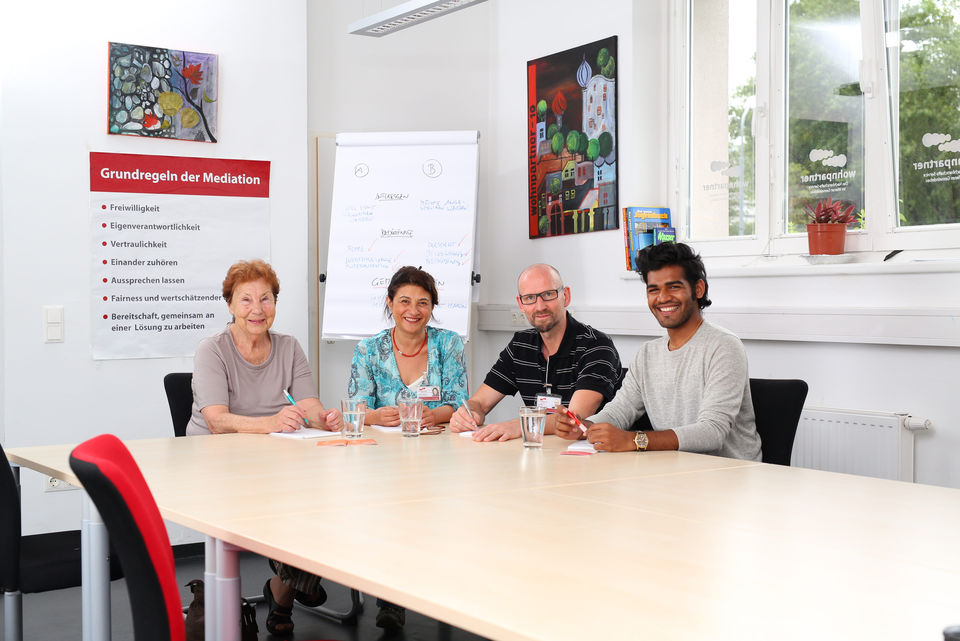
wohnpartner offers support with the goal of enabling the residents of municipal housing complexes to actively shape their living environment. Individual possibilities and coping strategies are expanded by empowering residents to try to resolve conflicts and find solutions by themselves. Thus, if conflicts arise between residents, wohnpartner offers professional help and advice in order for them to come to terms with different views, beliefs and needs. An example of this would be through mediation processes. Further actions and possible methods for implementation can be planned through coaching and counselling. wohnpartner adopts an multi-partial approach, inviting both or more parties, to take part in the conflict resolution process.
A Multi-Partial Approach
Conflicts do not only arise as a result of different views and needs. For instance, if a resident has to cope with some personal issues, he or she may have extra difficulties in accepting the behaviour of another neighbour, and could regard that person’s behaviour as the reason for the conflict. wohnpartner goes beyond this seemingly obvious explanation and seeks to address the underlying problem. To this end, wohnpartner involves other social institutions if needed and cooperates with a variety of agencies in order to address multi-layered social problems in municipal housing estates. Thus, wohnpartner helps foster better understanding within in the neighbourhood, but also aims to promote individual skills in dealing with everyday problems.
Cooperations with Schools
wohnpartner cooperates with schools in order to educate young people in conflict resolution. Through peer-mediation workshops, young people learn to accept and acknowledge the needs and views of other people and to communicate in a non-confrontational manner.