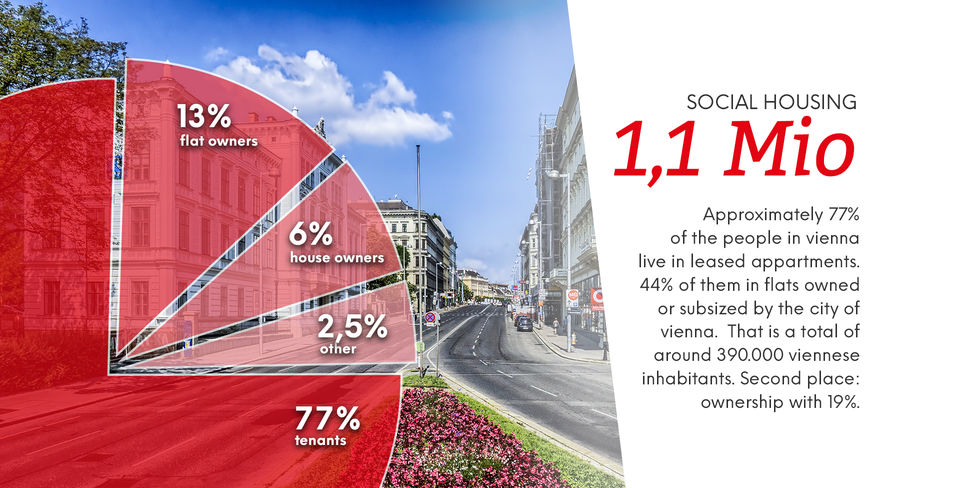
Out of a total of 901,900 housing units which are classified as the occupier’s main place of residence, 690,900 (77%) are rental accommodation:
- 299,400 (33%) are classed as private rental accommodation
- 212,000 (24%) municipal housing units and
- 178,600 (20%) rental flats owned by Limited-Profit-Housing-Associations (LPHA).
This results in a total of 391,400 (44%) housing units which are classified as social housing. The relatively low rate of home-ownership (19%) consists of 112,700 (13%) commonhold properties and 57,700 (6%) housing units which are occupied by the home-owners. The remainder are 40,600 (4%) properties classed as “other accommodation”, such as company housing or sub-tenancies. (Source: Statistik Austria, Census 2017)
Housing Stock in Refurbishment
Since 1984, approximately 2,000 private buildings containing 32,200 flats have been refurbished as a part of the “Gentle Urban Renewal Programme” and since 2001, around 900 private buildings containing 31,000 flats have been refurbished under the “Thermal Refurbishment Programme” (THEWOSAN). Furthermore, in around 2,000 private buildings (containing 35,700 flats), maintenance work and improvements have been subsidized. In total, approx. 100,000 (11%) additional flats in privately-owned buildings have been partially-financed by subsidies over the last 30 years.
Together with 32,600 (4%) commonhold properties which were originally built by LPHAs (Limited Profit Housing Associations) using housing subsidies, around 60% of Vienna’s inhabitants live in subsidized buildings. Vienna’s active housing policy addresses the housing market as a whole and tries to influence the private market as well. (Source: wohnfonds_wien, GBV)
New Housing Construction
In 2016, the City of Vienna launched the “Vienna Housing Programme 2016-2018” (Wiener Wohnbau-Initiative 2016-2018) to increase total housing production by 30% from 10,000 to 13,000 housing units per year. The number of subsidized housing units should be 70% or 9,000 apartments per year. An annual budget of around €300m was reserved for these purposes.